Why Can't I Stop Overthinking? The Psychology Behind It (and 7 Ways to Quiet Your Mind)
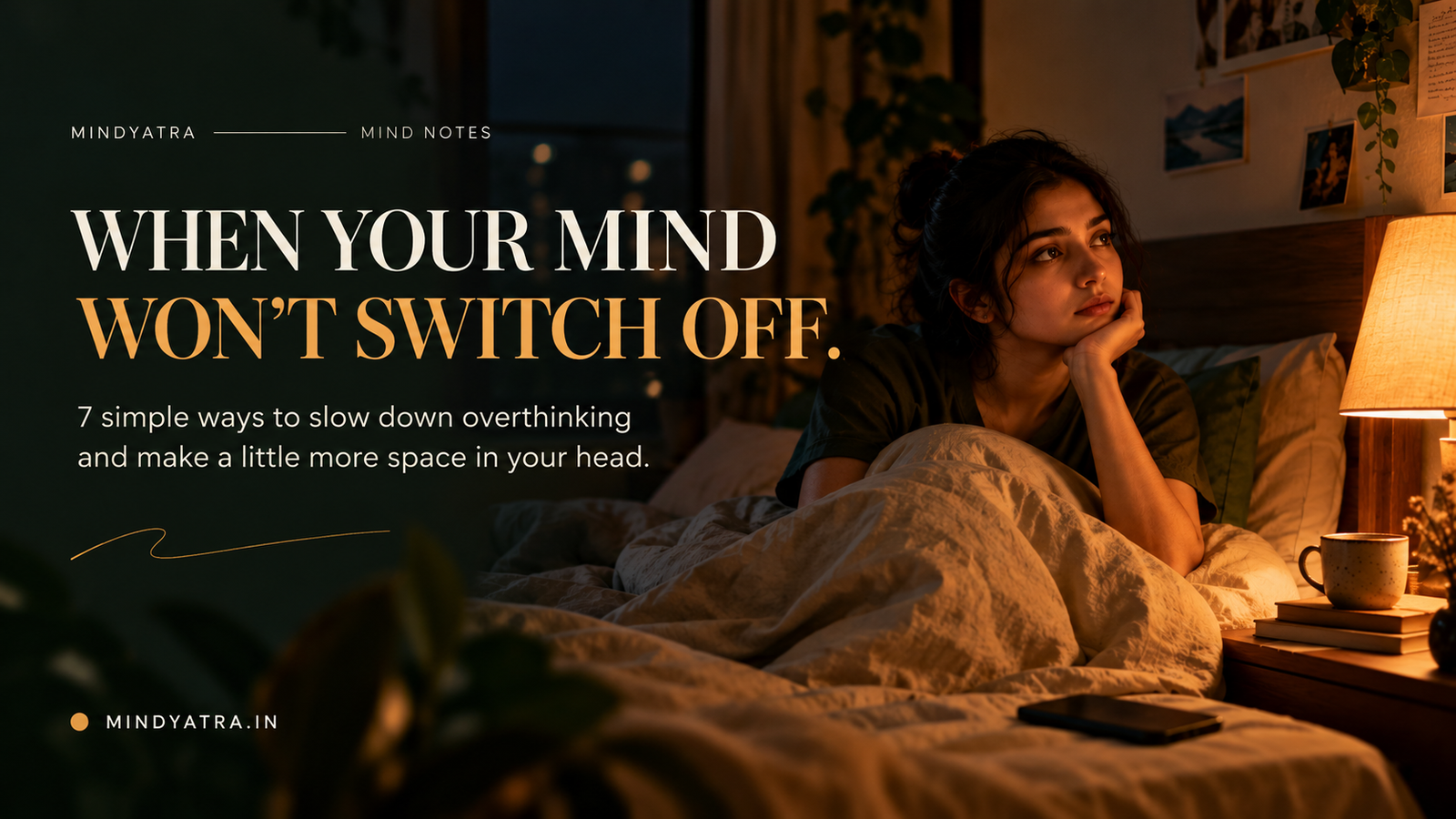
It's 1:40 AM. The day is over, the lights are off, and your brain has decided this is the perfect time to replay something you said in a meeting. Or the message you still haven't replied to. Or a much bigger question about where your life is going.
If that sounds familiar, you're in good company. Overthinking is one of the most common things people quietly deal with. Students feel it before exams and results. Working professionals feel it after long days and tricky conversations. Mothers feel it when the whole household keeps running in their head long after everyone else has gone to sleep.
Here's something worth knowing early: overthinking isn't a flaw in your personality. It's a pattern. And patterns can be understood, and slowly changed.
What is overthinking, really?
Overthinking is when your mind keeps circling the same thoughts without reaching an answer. It usually shows up in two ways.
Going over the past. You replay conversations, mistakes, or moments you wish had gone differently. Psychologists call this rumination.
Worrying about the future. You run through every "what if" before anything has actually happened.
Thinking things through is healthy. It helps you plan and make decisions. Overthinking is different because it doesn't take you anywhere. You come out of it more tired, not more clear.
Why do we overthink? The psychology in simple words
Overthinking isn't random. There are a few very human reasons your mind gets stuck in a loop.
Your brain doesn't like unfinished business. Moments that feel incomplete tend to stay active in your mind. An awkward conversation, an unanswered question, a decision you haven't made yet. When the day finally goes quiet, those open loops come back asking to be sorted out.
Worrying feels like control. Going over a problem again and again can feel like you're preparing for it. Your brain quietly mistakes worrying for problem-solving, even when nothing is actually getting solved.
Stress keeps your mind on alert. When you've been under pressure for a while, your mind keeps scanning for what could go wrong next. Small things start to feel bigger than they are, and it becomes harder to switch off.
Night takes away your distractions. During the day there are calls, classes, chores and notifications. At night, all of that disappears, and the thoughts you pushed aside finally get the space to speak up. That's why overthinking so often peaks right when you're trying to sleep.
Old habits run deep. Many of us grew up being told to get things right, think before we speak, and worry about what people will say. Over time, the mind learns to check and re-check everything, even when it isn't needed anymore.
Signs you might be overthinking
See how many of these feel familiar:
- You replay conversations long after they've ended
- You rewrite a simple message several times before sending it
- Your mind speeds up the moment your head hits the pillow
- Small decisions, like what to order or what to reply, feel exhausting
- You picture the worst possible outcome before anything has happened
- You feel mentally tired even on days when not much went on
If you nodded along to a few of these, there's nothing wrong with you. Your mind is simply working overtime, and it could use some help slowing down.
How to stop overthinking: 7 ways that actually help
You won't switch overthinking off overnight, and that's okay. The goal is to loosen its grip, one small habit at a time.
1. Notice it and name it. When you catch yourself looping, say it in your head: "I'm overthinking right now." It sounds simple, but naming what's happening puts a little distance between you and the thought.
2. Write it down before bed. Keep a notebook by your bed and jot down whatever is on your mind in a line or two. Once it's on paper, your brain feels less pressure to keep holding on to it.
3. Give your worries a time slot. Set aside 15 minutes in the early evening as your "thinking time." If a worry shows up later, tell yourself you'll deal with it in tomorrow's slot. It's surprising how many of them feel smaller by then.
4. Ask yourself one useful question. "Is there anything I can actually do about this today?" If yes, take one small step. If no, practise letting the thought sit there without chasing it.
5. Get out of your head and into your body. A short walk, a few stretches, or even washing your face can shift your attention. Movement gives your mind something else to focus on.
6. Go easy on late-night scrolling. Every reel, post and message gives your mind more material to chew on. Try putting your phone away 30 minutes before you sleep.
7. Say it out loud to someone. Thoughts tend to shrink once they're spoken. Talk to a friend, a sibling, a partner, or a professional. You don't need a solution, just a listener.
When overthinking is a sign of something more
Everyone overthinks sometimes. But if it has been going on for weeks and is starting to affect your sleep, your work, your relationships or your mood, it's worth paying closer attention. Constant worry, feeling on edge most of the time, or a heaviness that doesn't lift can sometimes be linked to anxiety or long-term stress.
That isn't something you have to push through on your own. Talking to a psychologist or counsellor can help you understand what's going on and what will actually help.
If your thoughts ever turn to harming yourself, please reach out right away. You can call Tele-MANAS on 14416, a free helpline available 24x7, or contact your nearest emergency service.
Understand your patterns with MindYatra
Overthinking rarely comes out of nowhere. It usually follows a pattern: certain triggers, certain times of day, certain loops you slip into without even noticing. Once you can see that pattern, it becomes much easier to change it.
That's exactly what we do at MindYatra. We start by understanding where you are, and then guide you towards the support that fits.
- Know Your Mental Health assessment: share a little about yourself, express what you're feeling through words, a drawing or a voice note, and get an expert-reviewed report within 24 hours.
- REVIVE: a guided 5-day process with a psychologist that maps your emotional patterns, stress triggers, behaviour loops and blind spots, so you can choose your next step with intention.
- Counselling and psychotherapy: ongoing, one-on-one support for when you need someone in your corner for longer.
You don't have to wait until things feel unbearable. Understanding yourself can start today.
Start your Know Your Mental Health assessment
Have a question first? Message us on WhatsApp at 9538186224 or write to mindyatra.help@gmail.com. We're happy to talk.
Frequently asked questions
Is overthinking a mental illness? No. Overthinking is a common pattern, not a diagnosis. Most people go through phases of it. But when it becomes constant and starts affecting daily life, it can be connected to anxiety or ongoing stress, and it's worth speaking to a professional.
Why do I overthink more at night? At night there are fewer distractions. The thoughts you kept busy with work, studies or chores during the day finally get room to surface. Being tired also makes it harder to step back from them.
Can you stop overthinking completely? Probably not completely, and you don't need to. The aim is to catch it sooner, understand what sets it off, and spend less time stuck in it. Small daily habits make a real difference over time.
What is the difference between overthinking and anxiety? Overthinking is a thinking pattern. Anxiety is a wider state that can include constant worry, restlessness, a racing heart and trouble sleeping. Overthinking can be part of anxiety, but not everyone who overthinks has anxiety.
When should I see a counsellor for overthinking? If it has lasted for a few weeks, is affecting your sleep, work or relationships, or you simply feel stuck and tired of carrying it alone. You don't need to wait for things to get worse before asking for support.